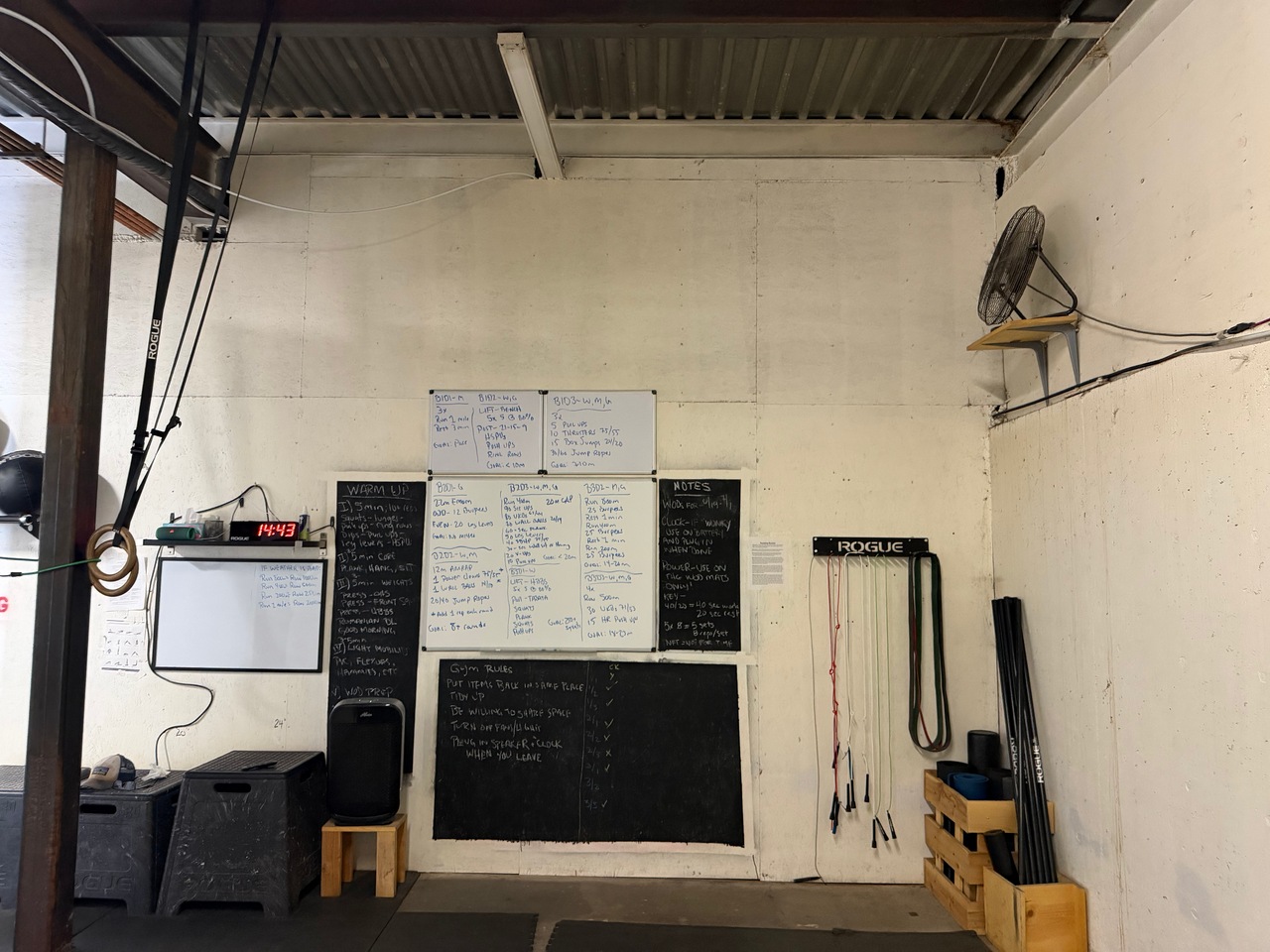
A workout is not one thing. It is an ordered set of blocks, each with its own job, and most days use four
or five of the nine kinds alongside. The blocks are reusable: a strength piece written once can be
programmed again three weeks later against the same numbers, which is what makes progression something you
can look up rather than something you have to remember.
Two things get decided before a single movement is chosen — the time domain and the rep volume. A session
is written to land in a duration bucket (a minute to five, five to ten, ten to twenty, twenty and up, or a
heavy day with no clock at all) and to a rep range of low, medium or high. Picking movements first is how a
month accidentally becomes six versions of the same twelve-minute AMRAP.
Only then do the movements go in, and they go in by pattern rather than by name. Squat, hinge, upper-body
push, upper-body pull, core: the block gets built out of the patterns it owes, and the specific movement is
the last choice made, not the first.
Loads are written the same way — as a prescription rather than a number, so a percentage of your own best
lift resolves to your weight and not somebody else's. Everything scales. The session is the shape of the
work; where you meet it is yours.
Nine kinds of block
Anatomy of a session
- Warm up
- Raise the heart rate and rehearse what is coming. Deliberately not the
workout in miniature.
- Mobility
- Range of motion, opened where the session is about to ask for it rather
than everywhere in general.
- Buy in
- A fixed piece of work that starts the clock — often the movement the
conditioning piece is about to punish.
- Strength
- The heavy, low-rep piece. It runs on its own progression across weeks,
so it is judged over a cycle rather than on the day.
- MetCon
- The conditioning piece and the scored centre of most sessions. Written
to a time domain first and a movement list second.
- HIIT
- Short, hard intervals with real rest between them. A different stimulus
from a metcon, not a faster one.
- Accessories
- The unglamorous work: single-limb, midline, and whatever a barbell
quietly lets you avoid.
- Cash out
- A short finisher. Optional by design, and never the reason the session
was written.
- Cool down
- Down-regulation. The part everyone skips, which is exactly why it gets
written down.